
Iran Oil Trade: Sanctions Enforcement and Regulatory Risk
As the Iran conflict continues to affect global energy markets, the maritime sanctions environment has become increasingly complex. We sat down with David Tannenbaum, Enco Advisor and Director of Blackstone Compliance Services, a sanctions and anti-money laundering advisory firm that specialises in maritime sanctions.
Enco Insights, London - 14 April 2026
Issues explored in this briefing:
Why have Iran’s oil exports held up despite sanctions and the Iran conflict?
Do US licences ease oil prices or deepen legal and enforcement risk for traders?
How exposed are global commodities markets to the Dark Fleet and maritime controls?
Enco Insights: How has the conflict affected Iran's ability to produce and sell oil and petroleum products?
David Tannenbaum: Iran’s oil and petroleum exports have not been significantly affected by the conflict. If anything, we have seen an increase in Iranian oil exports since sanctions enforcement dynamics began to shift. In addition, following the issuance of certain general licences, some data suggests that Iranian oil has moved from trading at a steep discount to trading at a premium.
Enco: How has the Dark Fleet adapted since the conflict escalated?
David: At the time of writing, more than 300 Dark Fleet tankers associated with Iran (excluding Russia) are actively exporting cargo to India, China and other Asian markets. This includes several dozen vessels operating off Malaysia that had previously been used as floating storage or were holding stranded cargo. Despite the broader conflict environment, Iran continues to load oil and petroleum products from its key export terminals. Satellite and radar imagery indicate continued tanker loading activity at Kharg Island, including the presence of VLCCs.
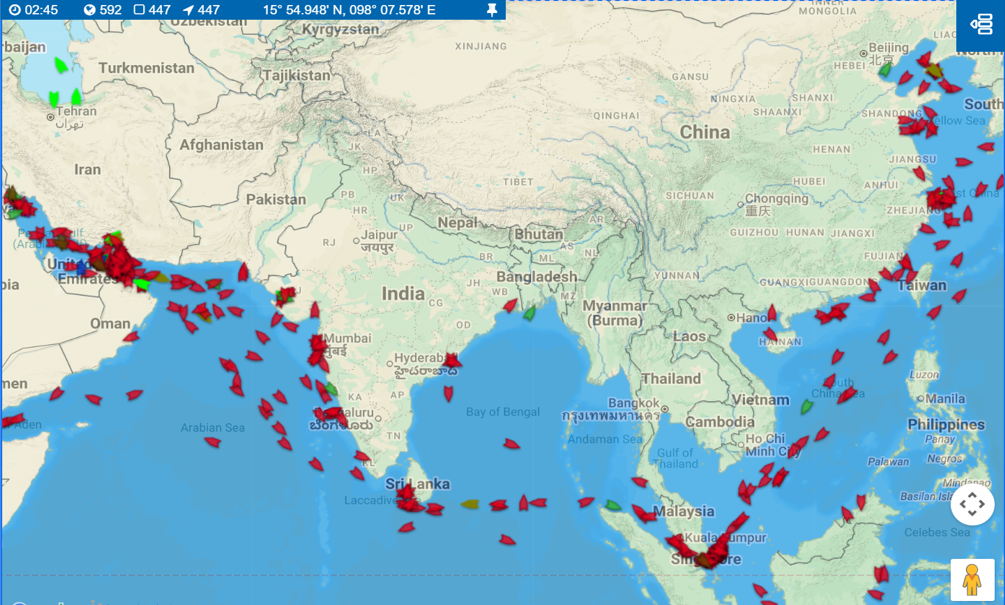
Vessel tracking data from Pole Star, Blackstone Compliance Services’ data partner.
Enco: What are the risks associated with Iran’s “tollbooth” in the Strait of Hormuz?
David: As widely reported, Iran has taken steps to control which vessels transit certain waters in and around the Strait of Hormuz. Vessels moving through Iranian‑controlled areas are reported to have paid tolls for passage. Payment of such tolls would likely violate US, UK and EU sanctions regimes, as well as multiple US criminal statutes prohibiting the financing of a Foreign Terrorist Organisation. While alternative routing options and mine‑clearing efforts may reduce pressure over time, these measures are neither immediate nor straightforward.
Enco: How should companies assess the risks associated with the US approach to vessels carrying Iranian cargo?
David: The current US approach has focused on preventing the movement of Iranian cargo rather than implementing a formal blockade, which would raise complex legal and political issues. Instead, we expect continued reliance on US asset‑forfeiture laws. US courts have shown a willingness to authorise the extraterritorial seizure of Iranian oil. In practice, enforcement efforts are likely to focus on vessels that are not legitimately flagged or cases where authorities can demonstrate that cargo is Iranian and obtain the necessary warrants.
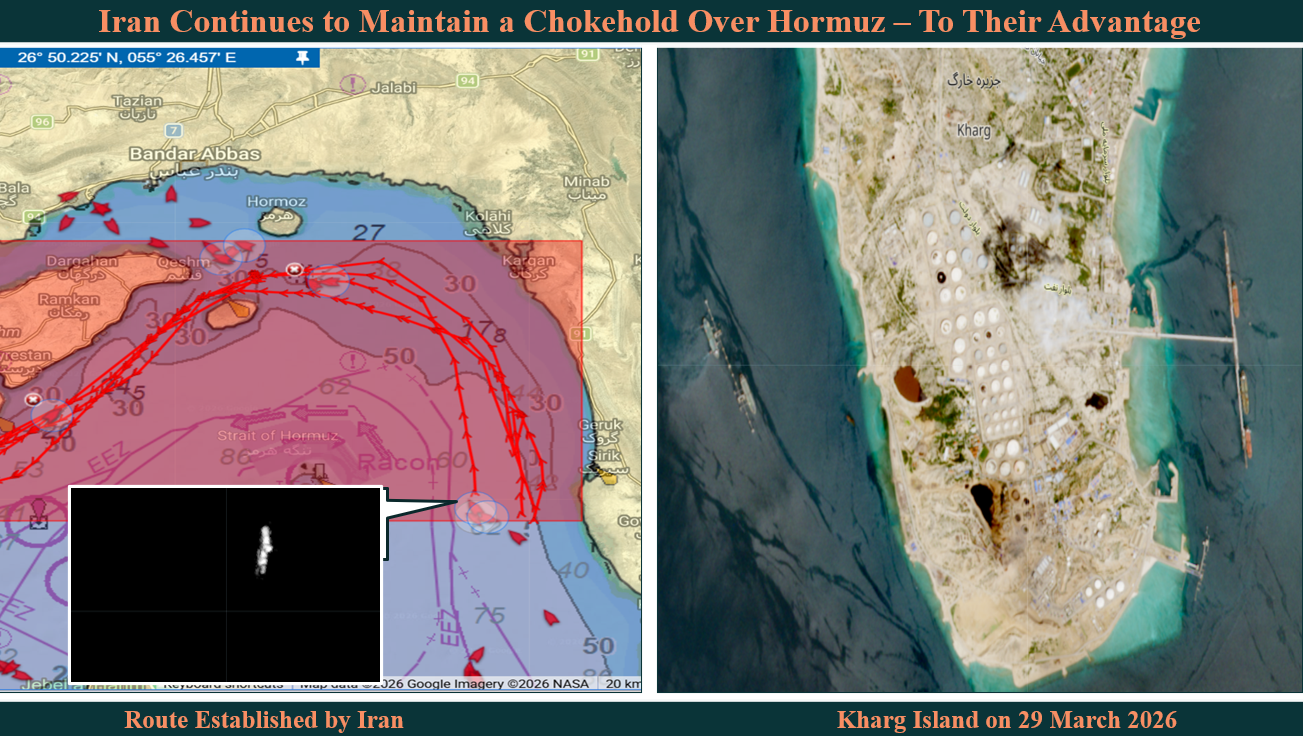
Left: Vessel‑tracking data from Pole Star’, Blackstone Compliance Services data partner, illustrating maritime traffic and routing through the Strait of Hormuz.
Right: European Space Agency Sentinel‑2 satellite imagery of Kharg Island on 29 March 2026, showing continued loading activity at Iran’s key oil export terminal.
Enco: The US has issued general licences permitting the sale or discharge of certain Iranian and Russian cargoes already on the water. What risks do these licences create, and how are market participants responding?
David: While these licenses may technically permit U.S. persons to engage in such transactions under U.S. sanctions laws, there are significant risks in doing so:
Limits to OFAC authority: While OFAC can authorise certain transactions prohibited by IEEPA, the U.S. law that underpins most sanctions, it cannot waive other criminal laws including those involving the financing of a Foreign Terrorist Organization ("FTO"), which would include the National Iranian Oil Company ("NIOC").
Civil litigation exposure: The U.S. law allows the victims of terrorism to sue parties that provide financial assistance to an FTO, and we expect that there will be many ATA lawsuits arising from these licenses.
Conflicting international sanctions regimes: Transactions involving the general licenses will almost certainly run afoul of U.K. and E.U. sanctions laws, and likely those of other G-7 members. Both the U.K. and E.U. prohibit transactions involving NIOC and other key Iranian entities, and Australia and Canada's laws prohibit transactions with the Islamic Revolutionary Guards Corp ("IRGC"), which has been repeatedly tied to NIOC.
For these reasons, many large commodities traders and financial institutions view these licences as offering limited practical upside once criminal, civil and reputational risks are taken into account. In some cases, they may even increase overall market risk by encouraging higher‑risk counterparties to re‑enter the market.

David Tannenbaum is an Enco Advisor and a Director at Blackstone Compliance Services, a sanctions and anti-money laundering advisory group that provides support to financial institutions and commodity traders. He is also a Partner at Polestar Global, a sanctions and maritime intelligence firm, where he runs the threat intelligence group.
“Iran’s oil and petroleum exports haven’t been affected. Instead, I’d argue that we’ve even seen an increase in Iranian oil exports since the U.S. began amassing forces for this attack in early February.”
Enco: What can commodities traders do to protect themselves from the legal, financial, and reputational risks associated with all of the Iranian oil currently on the market?
David: With all this illicit cargo on the water, and increasing interest in the Dark Fleet, it's now more important than ever to understand the origin of the goods and identify any red flags associated with the counterparties, vessel, or the cargo. There are numerous repercussions to dealing with a vessel in the Dark Fleet or Iranian cargo extend well beyond sanctions penalties and criminal charges:
Increased risk of having cargo seized or blocked at sea
Exposure to vessels operating with questionable or insufficient insurance
Operational and safety risks, as many Dark Fleet vessels are in poor condition
We are advising clients dealing in oil from certain areas, including originating from the outer port limits around Singapore and Malaysia, to collect all the necessary cargo documents, including notices of readiness and statements of facts, and validate that they are genuine. The Dark Fleet continues to engage in STS transfers, including with otherwise reputable floating storage vessels, to launder the origin of their goods. Finally, we recommend conducting due diligence on counterparties that are smaller or new trading firms located in the UAE, Iraq, India, and Malaysia, or when the buyer of the goods appears to be a front company located in Hong Kong.

How can Enco Advisors support you?
We connect seasoned industry practitioners with senior executives and leaders from across the energy and commodities markets globally. Engagements can range from a one-day session to a longer-term interim position.