
Transfer pricing is usually filed under tax. Yet in asset-backed commodity businesses it can quietly decide who looks profitable, who gets paid and where capital goes.
This means building the right system design for an organisation can have outsized impacts - as Enco advisors, Savvas Manousos, Anne Devlin and Jan-Peter Onstwedder explain.
Talking Transfer Pricing
Asset-backed commodity businesses often face a question that is harder than it looks: how to divide margin, and the credit for creating it, between assets and traders – and how to design a transfer pricing system that does so fairly.
This challenge was the subject of a recent edition of the HC Commodities Podcast, hosted by Enco’s Executive Director, Paul Chapman. Three Enco Insights advisors joined Paul to discuss transfer pricing: Savvas Manousos, who built and ran Maersk Oil’s trading capability; Anne Devlin, a former Global Crude Trading Originator at bp; and Jan-Peter Onstwedder, a former Managing Director at Citigroup.
This article is based on edited highlights from podcast. To hear the full episode, please click here, or press play on the podcast embed below.
Listen to the Podcast
“This is something that almost needs to be designed in a bespoke way for each company and circumstance. It has to be jointly built, not imposed. It’s got to be linked to the business strategy and not disconnected from it.”
More Than a Tax Question
Many energy companies now run trading arms alongside their physical assets, while once asset-light trading houses have bought infrastructure to secure their flows. Either way, internal transfer prices divide the margin between assets and traders. However, volatile markets and disrupted trade flows have made that division more consequential and harder to get right.
While most companies treat transfer pricing as a compliance exercise, Savvas Manousos sees this as too narrow: the internal price is how a company describes value to itself, and it influences which parts of the organisation appear profitable – and so where budgets, credibility and bonuses go.
And the sums at stake are far from trivial. In a 500,000 barrel-a-day refining system with $70 crude, Manousos calculates that every 10 cents a barrel of error in the transfer price moves around $36 million a year of profit from one part of the business to another – enough to change how each unit’s performance is judged.

“You don’t really want your tax strategy to drive the commercial strategy of an organisation. ”
The difficulty is that each side of the business can underestimate the other. “Traders can be seen as just executing orders at a screen price,” says Jan-Peter Onstwedder, while assets can be seen as fixed-cost processing units. “All those views are horribly simplistic.”
Trading, for its part, adds far more than execution. “In a well-run trading organisation, the trading adds market intelligence and optimisation around timing, for example, or logistical solutions,” says Anne Devlin. Put simply, “the trader is really somebody translating complexity into money.” The real question is how to measure that contribution – and that is where benchmarks come in.
The Benchmark Challenge
Benchmarks are the natural starting point for measuring who created value. The problem is that only a few crude grades, such as Brent, WTI and Dubai, trade liquidly; other grades, blends and biofuels are valued against them by formula. And as Devlin explains, benchmarks “each refer to a defined quality at a defined location and under defined conventions, whether timing or delivery.” Real cargoes rarely fit so neatly.
That leaves many businesses relying on approximations that are treated as objective market prices – and so are rarely challenged. Yet small differences can move large sums, and credit, between business units. “Getting a bad transfer price doesn’t just move margin. It ultimately decides who gets the credit for creating it,” says Manousos. “Weak benchmarks aren’t a pricing error. It’s governance failure dressed up as market logic.”
“You need everybody to understand the logic of the system. And you certainly don’t want disputes to drag on forever.”
Designing the Right System
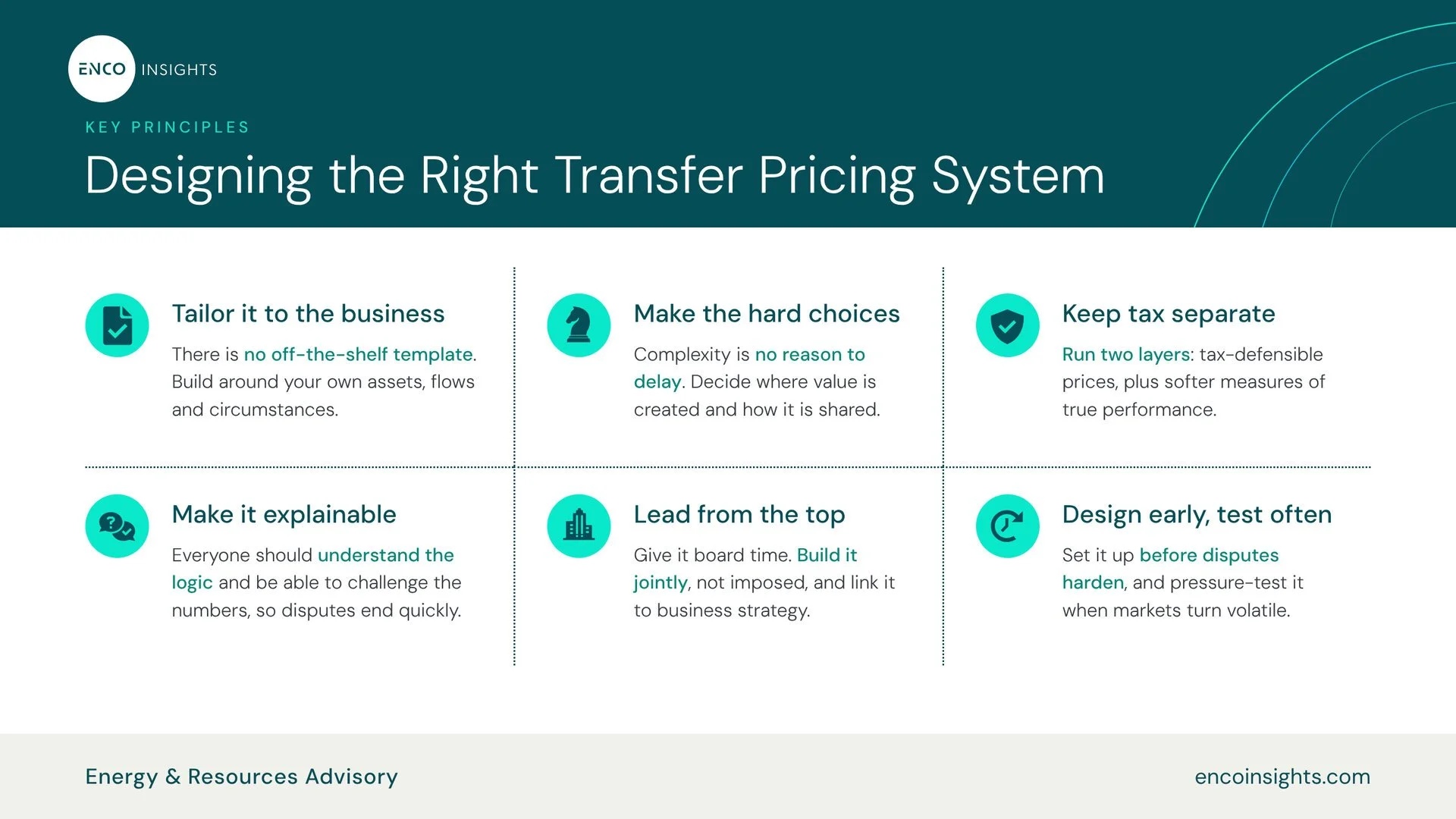
So if benchmarks are imperfect and incentives follow the numbers, what does good design look like? The first answer is that there is no template. “This is something that almost needs to be designed in a bespoke way for each company and circumstance,” says Manousos. Yet complexity is no excuse for standing still, Onstwedder adds: “You have to make some choices.”
Compliance adds a further constraint. In some cases, tax choices may shift reported EBITDA by 10–20%, Onstwedder notes. Even so, “you don’t really want your tax strategy to drive the commercial strategy of an organisation,” he adds. One way through, Manousos suggests, is to run two layers: “hard transfer prices from a tax and fiscal perspective” alongside “softer enterprise measures where people acknowledge that this was the true end-to-end performance.”
Whatever the structure, it has to earn trust. “If you can’t have that debate with a sufficient understanding, then you will just generate mistrust,” says Onstwedder. Devlin agrees: “you need everybody to understand the logic of the system. And you certainly don’t want disputes to drag on forever.”
That trust starts at the top – yet boards may give the subject little time. “I would be surprised if most boards talk about transfer pricing at all, certainly less than a couple of hours per year,” says Manousos. Instead, he argues, the system should be “jointly built, not imposed. It’s got to be linked to the business strategy and not disconnected from it.”
The common thread is design done early, before disputes harden, drawing on experience from the trading floor, the asset and the boardroom. As Manousos puts it, “the purpose of the internal market, the internal transfer price, is to improve enterprise decisions, not simply produce neat, defendable internal invoices.”