Asset-Backed Trading: Not Just a Producer's Game

Asset-backed trading, long dominated by energy majors and utilities, is attracting new entrants.
The former CEO of Maersk Oil Trading, and Enco Advisor Niels H. Lindegaard, explores the advantages of ABT and how to build a team.
Questions Explored in this Briefing:
Why are non-producers increasingly building asset-backed trading capabilities?
What does it take to build, govern and scale an ABT platform successfully?
How can advisors and advisory boards help organisations plan for ABT projects?
Asset-Backed Trading's New Participants
Enco Insights: Let's start with what the concept of asset-backed trading — what does this mean in practice, at major scale?
Niels H. Lindegaard: Asset-backed trading is not "trading, plus some assets". It is a trading capability whose edge comes from owning or controlling positions in the physical chain–storage, blending, transport, supply licences, production slots – so that trading decisions are both better informed and executable in ways a pure paper trader's are not. To dig deeper:
A tank (physical storage owned or leased) is not an asset held for its own return; it is an option on time and location. In practice: a front office transacting physical and paper, the infrastructure itself, a middle office owning exposure and mark-to-market, a back office that reconciles both, compliance — and above all one daily P&L combining physical and paper, so nothing can hide.
At small scale this is opportunistic. At major scale it becomes an operating system, where the constraint is never how many trades you can do but whether you can still see your own position accurately the next morning.
Enco: Have you seen the type of player in asset-backed trading change?
Niels: Yes - the players have changed recently and, I think, permanently. Early on they were producers and trading houses, then national oil companies and utilities — all of them people whose business was already the commodity itself. What is new is that the enquiries about entering ABT increasingly come from companies that produce none of it. After all, some of the largest commodity exposures in the world sit on the other side of the trade – such as shipping lines, steelmakers, fertiliser producers, airlines – where billions are spent each year through procurement. The resulting trading opportunities are prompting more of these organisations to explore how to increase the value of their core activities and explore how to develop their own ABT teams.
The consumer is structurally short – it must buy, every day, whatever the price – and is building for control. The producer is structurally long and is building for optimisation. Here is the part many people get wrong. Whether producer-side or consumer-side, the frameworks are identical, with no lighter version for either. What differs is the starting point and therefore the speed.
A producer has a running start: molecules, market insight in-house, and a board that already accepts commodity price risk. A consumer has none of those three, and the board is usually the real constraint. Nobody gets a plug-and-play version of this — the producer simply has a shorter run-up.
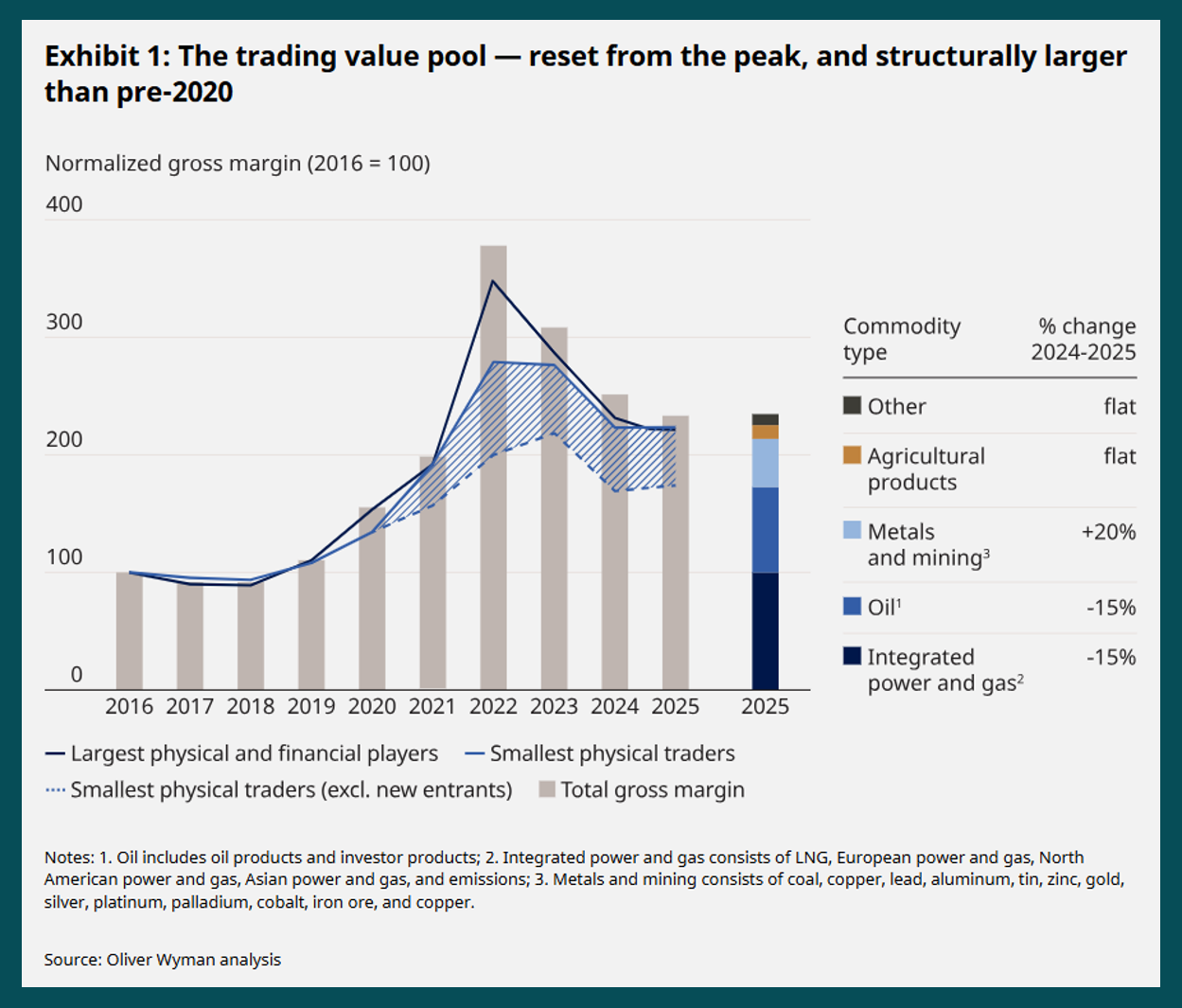
As Oliver Wyman notes, commodity trading has reset from its 2022 peak, although it remains roughly twice its pre-pandemic scale.
In this more normalised market, firms can be rewarded for extracting value from physical assets, logistics and portfolio optimisation.
“Before anything is built, an experienced outsider will tell you which parts of an ABT strategy do not survive contact with how these markets actually behave and, just as usefully, what not to do. That feeds directly into the execution decisions, which is where most of the money is lost or saved.”
Sourcing Advice on ABT Projects
Enco: How can senior leadership exploring ABT use advisory boards well — and what are the pitfalls?
Niels: For the company's own board, the value is calibration, and it tends to run in two phases:
Before anything is built, an experienced outsider will tell you which parts of an ABT strategy do not survive contact with how these markets actually behave and, just as usefully, what not to do. That feeds directly into the execution decisions, which is where most of the money is lost or saved.
Once you are building, the adviser tells you whether a number is alarming or routine — a large mark-to-market swing, or a month where the desk makes money for reasons nobody can quite explain. A board that has never traded has no reference points for either question.
For the executive carrying the mandate, it is different: experience that avoids repeating known mistakes or reinventing a wheel somebody has already built. Planning a build and running one are different capabilities, and the second is the scarce one.
The pitfalls divide the same way. The board's mistake is to let an advisory board stand in for its own understanding: you can take a pilot aboard, and in waters you do not know you should, but the master still carries the ship. The executive's mistake is choosing advisers for name recognition rather than for having lived through the thing you are about to do. And however good the advice, the mandate stays yours.

More companies are turning to advisory boards to help plan complex platforms such as asset-backed trading.
Enco: What does this trend mean for talent — and what culture can leadership create ahead of crunch time?
Niels: Early in a career the scarce skill is not trading. It is understanding how a physical cargo moves and everything that can go wrong with it. The best traders I hired could read a surveyor's report and had done a stock reconciliation themselves. At the top the scarce skill is someone who can hold a board's confidence while explaining a mark-to-market loss with an offsetting physical gain elsewhere in the accounts. That is the hardest hire in the build.
You buy the first generation and build the second. And you will replace specialists along the way: the person who is excellent at the first stage of a build is not the one you need at the fifth. That is not a hiring failure but the nature of a capability that changes shape every eighteen months. This calls for far more active career planning, helping each individual build the strongest CV they can get, because we all move on at some point.
As for crunch time, the cost of a problem roughly doubles for every day it stays hidden, so the only culture that survives is one where bad news travels upward fast and without penalty — and that is built in the quiet years, not in the crisis. In practice: a daily P&L everyone sees, including the uncomfortable lines; a middle office never overruled about a number; and limits enforced at least once when it was inconvenient. Limits that have never been tested are decoration, and everyone in the building knows which kind you have.
“The board’s mistake is to let an advisory board stand in for its own understanding. The executive’s mistake is choosing advisers for name recognition rather than for having lived through the thing you are about to do.”
Building an ABT Platform: Planning Phase
Enco: For a company whose only relationship with a commodity is that it buys an enormous amount of it, what is the real case for moving into trading?
Niels: Almost none of it is about trading profit. There are four objectives and the P&L is evidence they are working, rather than the reason to start:
Cost: A consumer buying delivered product pays a stack of intermediary margins: the local supplier, storage operator, blender, refiner, ocean freight. Every layer earns a margin on your volume. You either keep paying it or move horizontally into it and earn it yourself. Not becoming an oil company; just occupying the steps between it and your own consumption.
Quality: Take the example of off-specification marine fuel — a regular and expensive global problem that can damage ships' engines. The best defence is controlling each step–which cargo, which tank, which blend, which barge – because by the time the problem shows up, the fuel may be onboard and the ship at sea. For any specification-critical input, quality control is supply chain control.
Resilience: If supply is disrupted, prices spike and product can be unavailable. That means higher cost, but more importantly it risks failing to move the cargo of thousands of customers. Controlled storage and logistics are insurance against that — and unlike most insurance, they earn their keep in the years when nothing goes wrong.
Intelligence: Procurement tells you today's price; being in the market daily tells you where it is going — and once you sell to third parties in open competition, you have a performance measure nobody inside the company can argue with.
Enco: Should ABT platforms have derivatives, hedging and paper market capability from the start, or should it come later?
Niels: Neither, quite: it belongs third. All planning should include paper and derivatives from day one, but the capability itself comes after key steps that must be in place first:
See the spend: Get one global view of what you buy, where, at what quality, from whom.
Professionalise procurement: Try to put in place index-linked pricing, a deliberate term-versus-spot mix, credit discipline, a daily number against a market benchmark.
Price risk management: Hedge the exposure you already have, rather than taking positions.
Physical footprint: Embed storage and last-mile supply in your core locations.
Cargo trading and ocean logistics: Buy cargoes rather than delivered product.
Blending and production access: Optimise the specification you really need.
External sales: Monetise the assets beyond your own consumption.
Paper cannot be first, because a capability built before you can see your physical exposure hedges a number you do not know. It cannot come later either, because every level above the third adds physical risk - and a board carrying physical and price risk at once is a board that withdraws the mandate.
18 months to three years gets a producer there; consumer-side, five years is the minimum. You are not building a system — you are moving a board's risk appetite one level at a time.

Niels H. Lindegaard spent twenty-five years building and running Maersk Oil Trading, taking it from a five-person fuel procurement desk to a 110-strong global asset-backed trading organisation with offices in Europe, the US and Singapore. The business transformed the group's fuel supply chain robustness and resilience and delivered a landed fuel cost consistently below what procurement alone could reach. He now works as an independent adviser on fuel strategy and offtake in shipping and the energy transition.
Enco: Where is the real source of competitive advantage — and looking back at Maersk Oil Trading, what would you do differently?
Niels: Take the usual list: assets can be bought or leased, capital is the cheapest item on it, data is commoditising, market access is a function of credit and time, risk management is table stakes rather than an edge. All of it can be replicated in eighteen months by a competitor with money.
The advantage is the integration itself: the speed at which information from the physical chain reaches the person taking the position, and the willingness to act on it. A berth delay, a distressed cargo, a quality deviation — in an integrated business that is a trading signal within hours; in a disaggregated one it is a line in a monthly report nobody trades on. You cannot buy that: it is not a capability but a set of relationships and habits that takes years to lay down. After it comes the external benchmark and, most durable of all, the people. Which leads to what I would do differently:
Build the middle and back office ahead of the front office: Do not build alongside it — nearly everything avoidable that went wrong traces back to capability arriving in the wrong order.
No compromises on systems: Not even the temporary use of Excel.
Do not borrow the corporate functions: I relied on in-house middle and back office run by corporate finance and accounting, which on paper seems logical. But they work in a different culture, may lack capacity when the traders need them, and are not used to physical flows. Paying a cargo in 5 days means 5 days. A KYC now means now.
Build a stronger relationship with the board, earlier: Single sponsors get replaced, and every replacement is an interruption.
Go external sooner: Selling to customers who do not have to buy from you changes behaviour more than any internal KPI.
One thing I would say to a board at the start: decide what you are actually buying before you begin. If the honest answer is a better P&L, stop — the first bad quarter will end it.
The ABT Outlook
Enco: The world certainly feels more volatile. Do you see that becoming more enduring than the classic ten-year supercycle — and beyond shipping, which industries does it pull into this?
Niels: Whether volatility is permanently higher, I cannot tell you. But three changes look structural rather than cyclical: the drivers are now political rather than economic, and politics does not mean-revert on a ten-year clock; regulation has created price series with no cycle history; and the transition is opening new markets where what gets called volatility is mostly illiquidity.
What follows matters more than the forecast: there are three exposures, not one, and boards rarely separate them:
Price risk: This is hedgeable on paper, and most boards think it is the whole problem.
Availability risk: This is not: a financial hedge pays you money; it does not put fuel in the tank.
Quality risk: This is not hedgeable either — only control of the supply chain addresses it.
Asset-backed trading is largely a response to the second and third, which is why framing it as "procurement versus trading" misses the point.
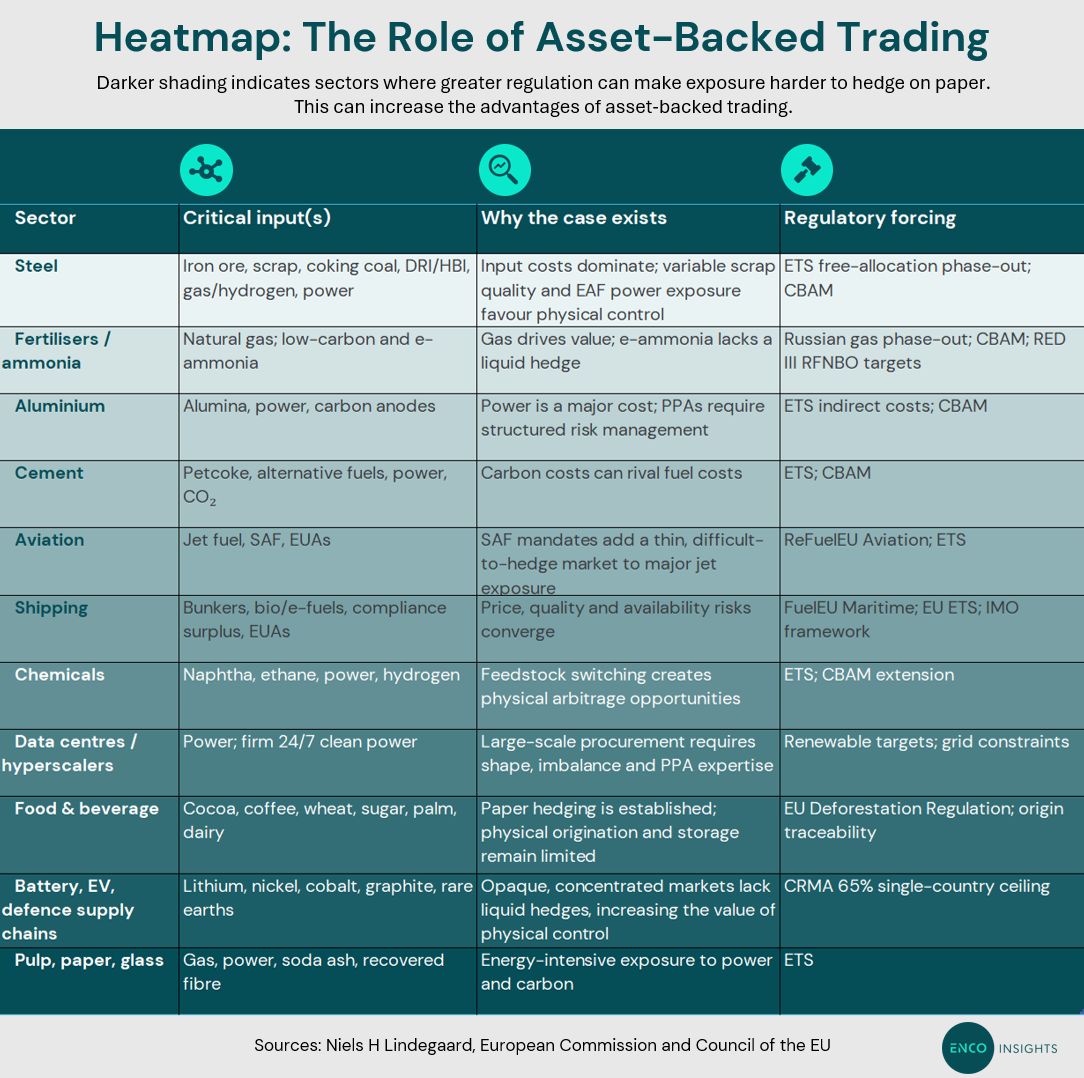
That also points to who is next: any company whose critical input is a large share of cost, carries availability or quality risk as well as price, and is being reshaped by regulation:
Steel, where ore, scrap, coking coal and power dominate cost and electric-arc capacity turns power into a trading matter, with the ETS free allocation phase-out and CBAM on top.
Fertilizers and ammonia, where gas makes ammonia and ammonia makes fertilizer, now compounded by the Russian gas phase-out, CBAM, and a shift to e-ammonia for which no liquid market exists.
Aviation, where sustainable aviation fuel is mandated, thin, expensive and unhedgeable.
Shipping, which spends more on fuel than many industries spend on anything, yet in twenty-five years has produced one company that built a genuine ABT organisation around that spend. The barrier is not economics. It is that boards see it as a different business rather than a means of managing supply chain exposure.
Cutting across all of them are ETS allowances, CBAM certificates, FuelEU compliance surplus and RED III tickets. These are already tradable commodities sitting on the cost lines of companies that have never traded anything. They are being pulled into trading whether they intend it or not. The question is whether they build deliberately or discover after the fact that they needed to.